
Are social enterprises really using ai?
First off, I'm already off track on my 2026 New Year’s Resolutions, 2 blogs a month was clearly over-ambitious. I'm downgrading my aspirations to 1 a month! So here we go.
Last year I took a short AI course run by SEI (thanks Bruno), that gave me quite the insight into just how little I know about AI, and also how much potential it has. I've been trying to upskill ever since, both in terms of how I can use AI effectively and responsibly within the context of my own social enterprise and in research but also more broadly investigate how AI can be used at a systemic level for the social impact sector. This blog helps to summarise what I’ve learnt so far.
At this year's World Economic Forum in Davos, there was reportedly a lot of discussion around the potential for AI to supercharge the delivery of social impact. Global AI spending reached $1.5 trillion in 2025. However, less than 1% of that investment is directed towards social impact.
The WEF's own work, through the Schwab Foundation's AI for Impact series with EY and Microsoft, contains some useful frameworks to help situate the potential of AI for social enterprises. Their PRISM model (Principles for Responsible Implementation, Scale and Management of AI) outlines three layers of AI implementation: impact mission and strategy, adoption pathways, and capabilities and risks. It's a good starting point. I love a good framework to help me solidify my thinking. It must be the accountant in me!
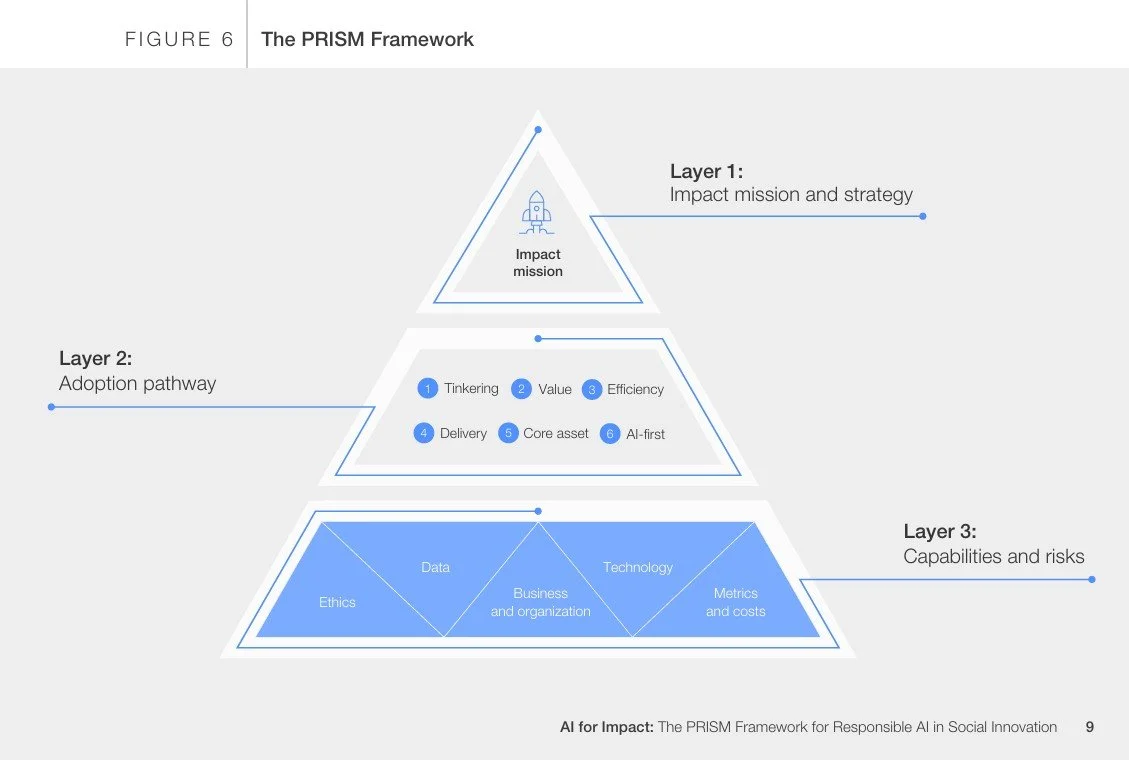
Source: World Economic Forum / Schwab Foundation (2024)
Nonetheless there is a tension in the WEF's position that I don't think they fully reconciled, which is that they've built these frameworks assuming a level of organisational capacity, data infrastructure, and technical resource that most social enterprises simply don't have access to. The WEF's own data shows that of all publicly available AI initiatives aimed at social impact, 43% focus on partnerships and networks and 18% on conferences, but only 7% focus on helping organisations actually learn how to use AI. So not only is the money not flowing to social enterprises to help them deliver social impact, but the support to help them actually adopt AI barely exists either.
The most helpful piece of research I found was Steiner, Mazzei, Calo and Liu (2025), (big fan of their work in general!) published in the Journal of Social Entrepreneurship. They surveyed 92 social enterprises in the UK about their AI adoption and the findings are important because they put evidence behind where things are practically. Social enterprises are adopting AI cautiously and incrementally. The tools being used are largely low-cost or free: content generation, basic process automation, customer communications, ChatGPT and its equivalents. The vast majority, 80%, had spent less than £1,000 on AI implementation. There is no evidence to suggest that social enterprises are substantially deploying machine learning systems or predictive analytics. The gap between what's being used on the ground and what's being discussed at Davos is considerable. The conclusion of this research stands out - AI is functioning as a sustaining technology in social enterprises, not a disruptive one. 72.7% of adopters believed AI would complement and enhance their services rather than replace them. Social enterprises are using AI to do what they already do, a bit faster and a bit cheaper, which is useful but a long way from the "AI for systemic change" narrative. Granted this research was published in 2025, meaning the data was probably collected in 2024, so I'm sure things have changed, but probably not as dramatically as one might imagine.
The question then is why the gap exists, and the research points to barriers that are structural rather than technical. The conversation about AI in the social enterprise sector tends to focus on which tools to use and how to get started, but as Ramanathan and Fruchterman (2025) argue in SSIR, the fundamental challenge for the social sector is data. Most social enterprises collect data to meet funder requirements, not to build systematic datasets. Data collection tends to be one-off and compliance-driven, and there's no pooled, sector-level data infrastructure. Without that foundation, the most sophisticated AI tools in the world won't help you much. What Ramanathan and Fruchterman argue, and what I think is particularly relevant for Ireland, is that this isn't just a "gather better data" problem. Their framework has three parts: gather, share, and build. Gathering better data is the first step, but the real shift comes from sharing data across organisations through interoperable infrastructure, and then building AI solutions collectively rather than each organisation going it alone. They give the example of crisis helplines pooling anonymised data across multiple organisations to develop shared AI tools, and they argue convincingly that the social sector has a genuine opportunity here to approach data radically differently from the for-profit world, where data is hoarded as competitive advantage. To say it feels like we are a million miles away from this is an understatement. Perhaps the New Solutions Social Innovation Hub could have a role in doing this?
Layered on top of this is a cost problem. Olla (2026), also writing in SSIR, published a projection of how AI tool pricing is likely to evolve for the social impact sector. Right now, many social enterprises are using free-tier AI tools, which works adequately for initial experimentation, but the trajectory shows that in the current period 2025-26, advanced features will move to paid tiers; by 2026-27, free tiers may become slower and more limited; by 2028-29, most useful AI will become subscription-based; and by 2030, it's expected to be metered like a utility. What this means is that social enterprises are building workflows around tools they may eventually be priced out of. Olla's point is that this isn't a reason to disengage from AI but a reason to engage differently, with what he calls a "rails, not rockstars" model, where the focus is on shared infrastructure, pooled resources, and collective bargaining rather than individual organisations each trying to keep up with the latest tool. For me personally, I've hopped between a lot of different AI options trying them all out, but currently only have three subscriptions, Claude Pro (I recently upgraded to the higher pro level because I get so much use out of it), Nano Banana for image-based work (where I really don't know what the dickens I'm doing, but learning!) and Scholarcy that I use to pre-read research. I also use the free version of research rabbit and consensus to help identify related research but haven’t used them enough (yet) to justify paying for a subscription.
Hanna and Nowack (2025) tracked $290 billion in AI venture capital between 2019 and 2024, with less than 1% going to social impact. They argue that this concentration of funding in profit-driven applications is widening inequality in three ways: it diverts technical talent and research capacity away from social impact, the funding that does exist goes predominantly to initiatives in high-income countries, and the AI models being built are trained on datasets that underrepresent the very populations social enterprises serve (if you haven’t read the new age of sexism or Invisible women this is important reading when using AI). The money isn't flowing to social enterprises yet, and the ecosystem that would need to exist to support them, the training, the technical support, the shared infrastructure, is still emerging, particularly in Ireland. These aren't problems that individual social enterprises can solve by downloading a better app, I think it’s up to our ecosystem to support the development of this. In addition, social enterprises express genuine concern about bias, transparency, and the environmental impact of AI systems, and there's good reason. Olla (2026) notes that data centre electricity demand is projected to more than double by 2030.
The ownership of AI models is of significant importance. In a past life I was a very enthusiastic user of the artist formerly known as Twitter, but in recent months, like many others I couldn't stay on the platform under its current ownership. There is a similar concern with ownership of AI models. In response to this, Scholz and Esposito (2026) in SSIR describe what they call a "solidarity stack," referring to cooperative data centres, AI cooperatives, and federated infrastructure owned by communities rather than tech companies. Apparently 1.2 million workers across 53 countries are already building elements of this, from data stewardship cooperatives in Switzerland to content moderators in Kenya forming their own worker-owned tech cooperative. It resonates deeply with social enterprise values, though whether it can scale fast enough to offer a genuine alternative to big tech dependency is another question.
Having gone through all of this research, I keep coming back to a few things. Start modest and don't apologise for it. Using AI for content generation or process automation is a perfectly rational starting point and you don't need to be building predictive models to be doing it right. The advice seems to be to invest in data practices before you meaningfully invest in AI tools. Clean, systematic data collection will serve you regardless of what happens with AI, and if your data is only good enough to satisfy a funder report, it's probably not good enough.
We need to think collectively. The data infrastructure problem and the cost trajectory problem are both sector-level challenges, not individual ones. Ramanathan and Fruchterman's "gather, share, build" framework gives us a practical way to think about this: gather better data within your own organisation, share it through interoperable infrastructure with others working on similar problems, and build AI solutions together rather than alone. This is where intermediary organisations and networks have a role. We need to be having these conversations as a sector rather than leaving individual social enterprises to figure it out alone.
At a sector level, I think we are behind. In Ireland, there is no coordinated conversation about AI infrastructure for social enterprises. None of the major intermediaries or government departments have published a position on AI and the social enterprise sector, at least not publicly that I've come across (if you know of something, please do share it with me). I know some are offering good training which is a very positive start. If we want social enterprises to adopt AI responsibly and sustainably, rather than just individually tinkering with various tools, we need it on the agenda for 2026, many social enterprises are moving past tinkering into proof of value and efficiency enhancement and I’m sure there are others that are far beyond that – but I would imagine they are the exception. That's a conversation worth having, and I don't think we've properly started it yet, I’m looking forward to being part of it!
References:
Hanna, H. & Nowack, D. (2025). Bridging the AI Investment Divide. Stanford Social Innovation Review. https://doi.org/10.48558/EFXJ-JQ63
Olla, P. (2026). The Low-Cost AI Illusion. Stanford Social Innovation Review. https://doi.org/10.48558/0K7X-GB75
Ramanathan, N. & Fruchterman, J. (2025). Gather, Share, Build. Stanford Social Innovation Review. https://doi.org/10.48558/95YT-BQ31
Scholz, R.T. & Esposito, M. (2026). Building a Solidarity Ecosystem for AI. Stanford Social Innovation Review. https://ssir.org/articles/entry/artificial-intelligence-solidarity-ecosystem
Steiner, A., Mazzei, M., Calo, F. & Liu, G. (2025). How and Why Social Enterprises Adopt Artificial Intelligence: Opportunities, Challenges, and Future Implications for Research and Practice. Journal of Social Entrepreneurship. https://doi.org/10.1080/19420676.2025.2584843
World Economic Forum / Schwab Foundation for Social Entrepreneurship (2024). AI for Impact: The PRISM Framework for Responsible AI in Social Innovation. In collaboration with EY and Microsoft. https://www.weforum.org/publications/ai-for-impact-the-prism-framework-for-responsible-ai-in-social-innovation/